


California needs to slow down the push for battery-electric (BEV) trucks. It is not just a matter of feasibility, technology and infrastructure. It is a matter of public safety.
In the past three months, there has been a series of fires caused by lithium-ion batteries resulting in the spewing of toxic fumes and the shutting down of major freeways and port operations.
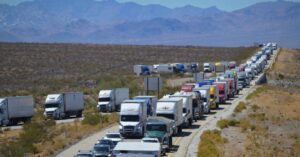
On July 26th, a truck carrying lithium-ion batteries was involved in an accident, and the batteries caught fire. The resulting heat from the fire, fear of additional explosions, and emission of toxin fumes shut down I-15 in 110 degree weather for two days stranding motorists (pictured left above).
On August 19th, a Tesla semi truck was involved in a single-vehicle accident and caught fire on I-80. The fire burned so hot, it was hours before firefighting aircraft could even approach the scene. The toxin fumes and heat shut down the freeway in both directions for 16 hours while firefighters used 50,000 gallons of water to extinguish the fire and prevent it from spreading to the adjacent forest (pictured right above).
On September 26th, an overturned big rig carrying a lithium-ion battery storage pack caught fire and shut down access to the Vincent Thomas Bridge. The harmful fumes shuttered operations at several marine terminals at the ports of Los Angeles and Long Beach for four shifts. The roadway was closed for nearly 40 hours before the truck and debris could be removed. For environmental reasons, fire crews opted to let the fire burn out rather than use water.
These circumstances occurred in the infancy of BEV trucks. What will the environmental toll be by the time we are set to be 100% BEV for both cars and trucks?