
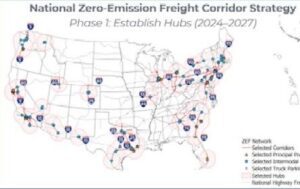
In the push towards zero emission vehicles (ZEV), the federal government has come to realize they cannot quickly and effectively replicate the 40,000 commercial fueling stations across the country with electric charging or hydrogen stations. Instead, they have come up with a plan to concentrate on “freight corridors.”

The map above (click map for larger view) represents the “freight corridors” the federal government will prioritize in the development of ZEV infrastructure. If you are in Kansas, Idaho, Tennessee or a host of other states, you are out of luck.

What is the cost of being ZEV ready? The answer is $1 trillion…$620B for infrastructure and $370B to upgrade the electrical grid. And, that does not take into the account the added costs of ZEV trucks.

Latest News

HAPPY NEW YEAR!!!

As we reflect on 2025 and aspire for 2026, we want to take the opportunity thank you all. To our customers, your trust in us is never taken for granted and is always appreciated. To our drivers and partners, your commitment to safely delivering cargo shines and is...

CARB COMTEMPLATES

As you remember, the California Air Resources Board (CARB) withdrew its zero emissions program, ACF, and the Feds nixed CARB's companion program, ACT. We knew CARB would not go quietly into the night, and they have begun to formulate their next plan. Some of their...

HACEGABA TAKES HELM

Congratulations to Dr. Noel Hacegaba who was named the Executive Director of the Port of Long Beach. Mr. Hacegaba has been with the port for fifteen years, most recently as its Chief Operating Officer. He takes over from Mario Cordero who retired at the end of 2025.

CONTENTIOUS CDLs

There has been much back and forth on the subject of non-domiciled commercial drivers licenses (CDL) and recap is in order: September 29, 2025: The Federal Motor Carrier Safety Administration's (FMCSA) interim final ruling went into effect requiring drivers to be...

SHE BELIEVED SHE COULD, SO SHE DID

SHE SAILS Kudos to CMA CGM for developing a recruitment program aptly named "She Sails" to increase the number of female seafarers in its ranks. The program has been successful, doubling the number of women working on vessels from 200 to 403 in its first year.  ...

Share This